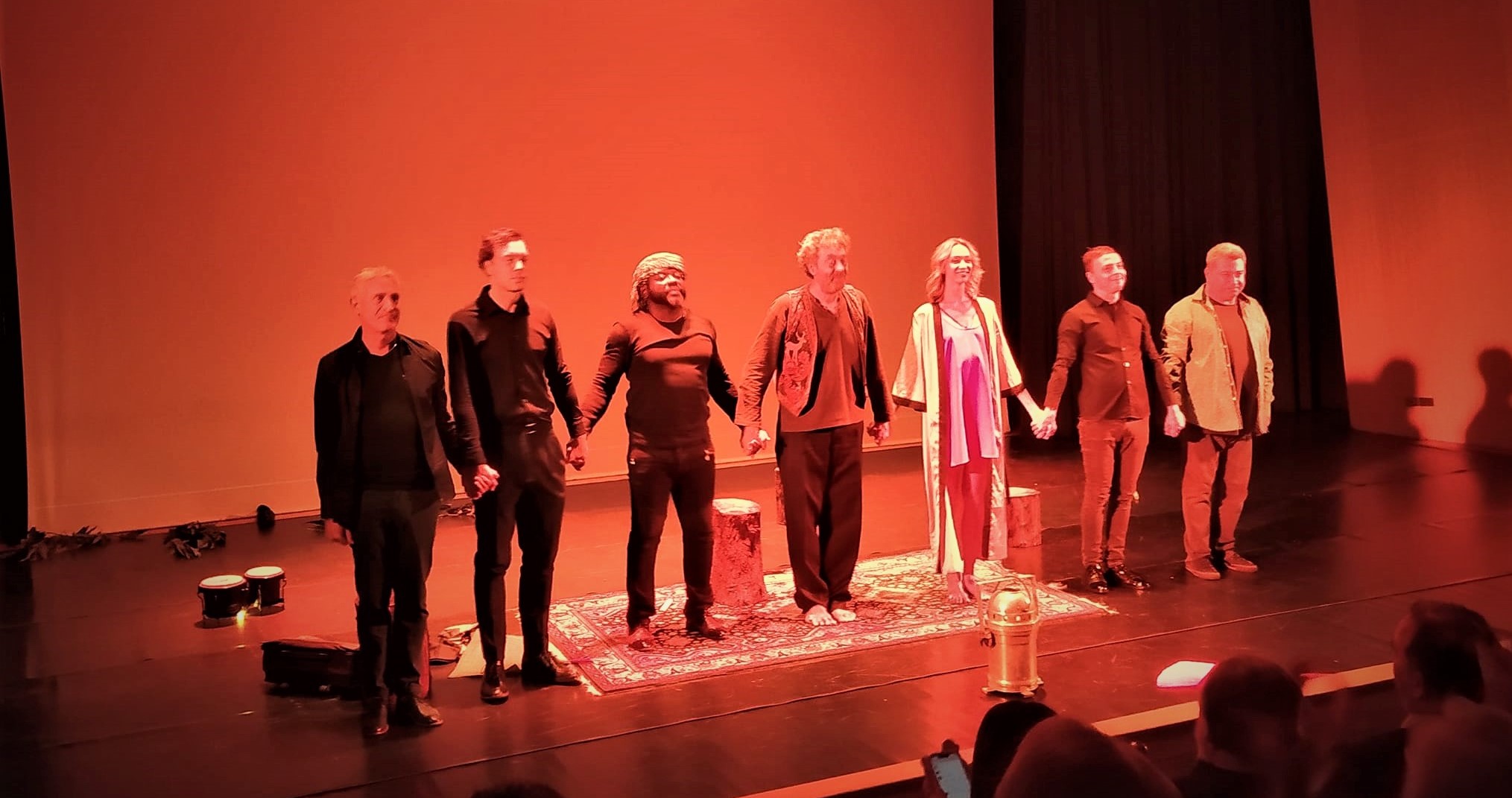
As part of the cultural events included in the Italian Festival in Thailand, in the prestigious venue of Alliance Française Bangkok, the play entitled "Six Characters looking for Pier Paolo," an original theatrical production inspired by two of the most famous and beautiful masterpieces of Italian Culture such as Pier Paolo Pasolini and Luigi Pirandello, was presented by the Italian Embassy in Bangkok. Performers: Willy Zogo, Liza Kaylee, Franco De Crescentiis, Matas Danielius, Maurizio Seu, Maurizio Mistretta, Michelangelo Cicero.
The event was attended by Italian Ambassador to Thailand H.E. Paolo Dionisi, in his very first public appearance since recently receiving the prestigious assignment.
The script of Six Characters in Search of Pier Paolo is a real drama that begins on a theatre stage under construction. The theatre’s director is watching Pasolini's film "What are the Clouds?" to be inspired by the movie for the creation of his new show. The film is strongly engaging, but, suddenly, the arrival of a series of people abruptly interrupts it. Those people look unreal and weird and they present themselves as characters in search of an author. The enraged Director tries to send them away, but the characters are adamant: they must bring their story to life, a very dark story: a story of Dark Jealousy.
Six Characters in Search of Pier Paolo is an original theatrical production inspired by the two most beautiful masterpieces created by Pier Paolo Pasolini and Luigi Pirandello. The first masterpiece is the famous short movie "What are the Clouds?" by Pasolini. The second masterpiece is “6 Characters in Search of an Author” by Pirandello. The latter is famous for being the forefather of the so-called theatre in theatre concept, introducing a new type of scenic action that will mark a turning point in the entire Italian theatre scene to date - the birth of confidential theatre. In his splendid and poetic short movie "What are the clouds?" Pasolini moves following patterns and languages loved by Pirandello, albeit adapted to the language of cinema. Pasolini, like Pirandello, shows us the double level of staging: on one hand, the tragedy represented by the puppet characters, and on the other hand, the perspective according to which the "spectator" would be only a falsely privileged observer. In fact, the audience is deprived of the possibility to both watch and perceive the dialogues and the pure actions of the characters. The spectator cannot descend into the abyss of the representation that takes place. It looks like Pasolini invited us to watch the film, finding the "truth" out of the deception: the good from the evil, the reality from the fiction, and the important things from the futile ones. In short, as in a sort of cinema in the cinema, Pasolini continually offers us double levels of interpretation, setting the main action of the short in a countryside theatre, letting the theatre’s audience interact and even to modify the classic epilogue of Othello. Every single moment of the drama is enlightening the basic separation between the world of fiction and the real world, up to the reflection on the meanings of human existence and on the relationship between "appearing and being", between life and death.
RIPRODUZIONE RISERVATA © Copyright Prima Notizia 24